On November 11, 2025, shortly after sunset, the Aurora Borealis became visible over Boulder County, Colorado—an extraordinary sight at this latitude.
Geomagnetic Storm Conditions
That night’s geomagnetic storm reached an extremely rare intensity: G4 on NOAA’s G-scale (with G5 being the maximum). The global Kp index climbed to approximately 8.7, near the highest levels ever recorded.
(Aurora sightings at this latitude typically require a Kp index of 8 or higher.).
Such conditions make it possible for the aurora to be seen far south of its usual range.
(Forecast data was provided by the NOAA Space Weather Prediction Center.)
From My Front Yard
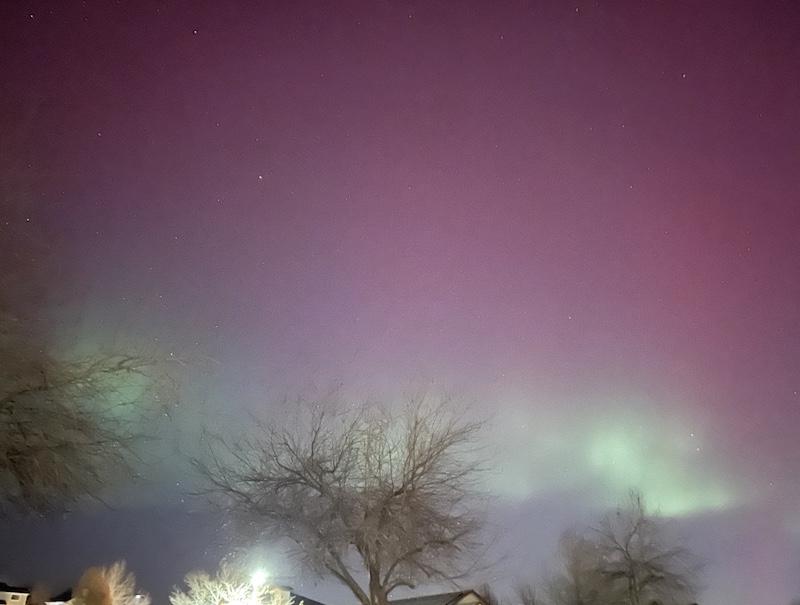
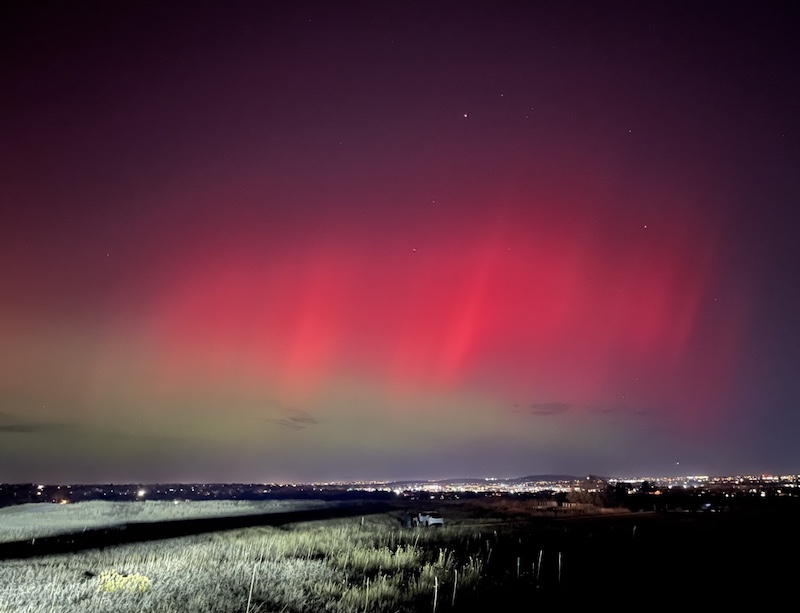
Near the end of the display, the aurora was visible even from my front yard as a faint, cloud-like glow. When photographed with an iPhone 13 mini, the lower portion of the sky appeared green, while the upper region showed reddish-purple hues.
Preparing to Photograph the Aurora
The first rule of aurora photography—as with all night-sky imaging—is to find a dark location. We brought cameras, a lightweight tripod, and an ultra-wide lens (Laowa 6 mm, equivalent to 12 mm full-frame) to a trailhead with minimal light pollution.
Davidson Mesa (Louisville Area)
We parked near Harper Lake and captured the aurora reflected above the water shortly after 8:00 p.m. local time.
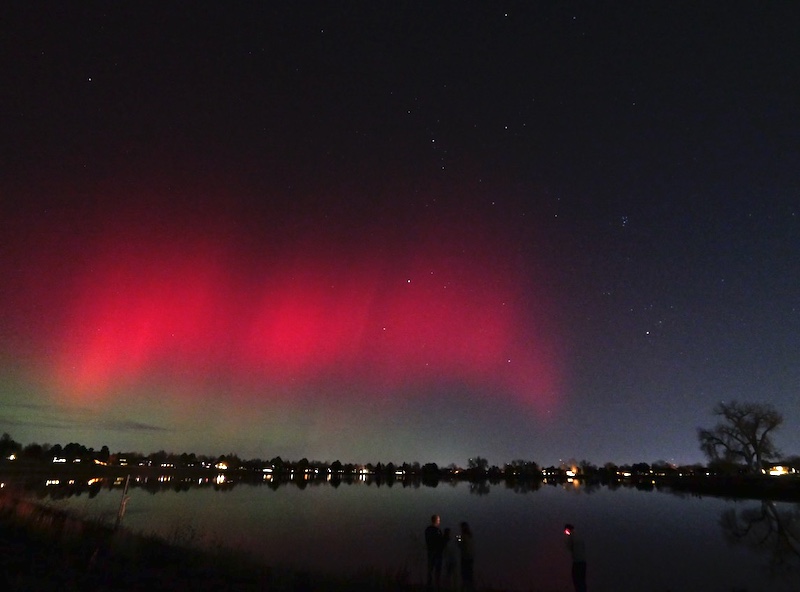
Camera: Lumix G100D + 8–18 mm (16–36 mm equivalent)
Why the Colors Appeared
The green and red colors in the sky were caused by energy transitions in oxygen atoms at different altitudes.
- Green emissions typically occur around 100–150 km
- Red emissions occur higher, above 200 km
Some reddish-purple and blue tones were produced by nitrogen emissions at lower altitudes.
Aquarius Trailhead (Louisville)
We also photographed the aurora from the Aquarius Trailhead using an iPhone 13 mini. Interestingly, the smartphone images appeared more vivid than those taken with our mirrorless camera—thanks to the phone’s computational night mode processing.
Reflections on Shooting the Aurora
Although we used both a mirrorless camera and an iPhone, the iPhone produced the most vivid results due to its internal image processing and long-exposure night mode. This highlights how modern smartphones can sometimes outperform traditional cameras in extreme low-light situations.
In Conclusion
Seeing the aurora from Colorado is an experience few people have in their lifetime. Many locals around us said it was their first time ever witnessing it.
While places such as Whitehorse, Yellowknife, or Fairbanks are classic aurora destinations, this night underscored just how extraordinary such a sighting in Colorado truly was.
Related Link
Aurora Dashboard – NOAA Space Weather Prediction Centerhttps://www.swpc.noaa.gov/communities/aurora-dashboard-experimental
30-Minute Aurora Forecast – NOAA SWPC
https://www.swpc.noaa.gov/products/aurora-30-minute-forecast
Aurora Photography Book
Book: The Northern Lights
The Northern Lights: Celestial Performances of the Aurora Borealis